Dementia progression varies for each individual, but most people move through the stages over several years. Early stages often last the longest, while later stages may involve more rapid decline and increased care needs. Understanding how long each stage of dementia lasts can help families prepare, plan ahead, and provide the right level of support at every step
Dementia Stage Timeline at a Glance
- Early stage: Typically lasts 2–4 years
- Middle stage: Can last 2–10 years (often the longest stage)
- Late stage: Usually lasts 1–3 years
👉 These timelines vary based on the type of dementia, overall health, and level of care.
In this guide:
- How long each stage of dementia lasts
- What affects dementia progression
- What to expect at each stage
- How families can prepare
HOW LONG DOES EACH STAGE OF DEMENTIA LAST?
Dementia does not follow a fixed timeline, but most individuals progress through three general stages: early, middle, and late. Each stage brings different challenges, and the length of time spent in each stage can vary significantly.
Some people may remain in the early stage for several years, while others may progress more quickly depending on the type of dementia and other health factors.
Learn more about how fast dementia progresses and what influences the timeline.
WHAT AFFECTS HOW FAST DEMENTIA PROGRESSES?
Several factors influence how long each stage lasts:
- Type of dementia (Alzheimer’s, vascular, Lewy body, etc.)
- Age and overall health
- Access to care and support
- Daily engagement and activity levels
- Presence of other medical conditions
Can dementia progress quickly?
Dementia is typically gradual, but certain health events such as infections, falls, or hospitalizations can lead to a sudden decline.
WHAT TO EXPECT AT EACH STAGE OF DEMENTIA
Early Stage (Mild Dementia)
Typical duration: 2–4 years
In the early stage, symptoms are often subtle and may include:
- Mild memory loss
- Difficulty finding words
- Trouble with planning or organization
Many individuals can still live independently but may begin to need occasional support.
Middle Stage (Moderate Dementia)
Typical duration: 2–10 years
This is often the longest stage and involves:
- Increased confusion and memory loss
- Difficulty with daily activities
- Behavioral changes or mood swings
At this stage, individuals typically require more consistent care and supervision.
Late Stage (Severe Dementia)
Typical duration: 1–3 years
In the final stage, symptoms become more severe:
- Limited ability to communicate
- Significant cognitive decline
- Full-time care required
👉 This stage often requires specialized support in a structured care environment.
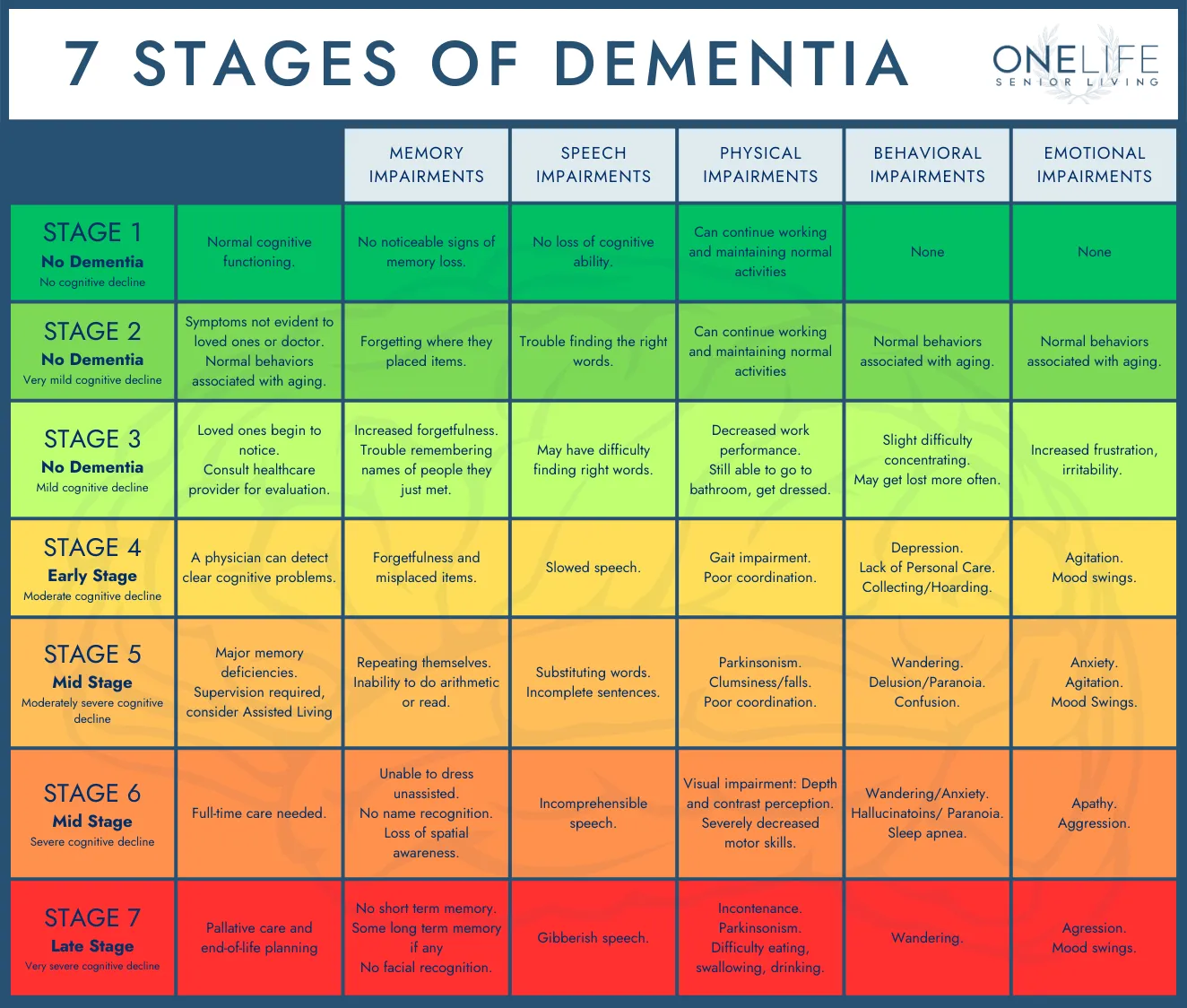
HOW THE 7 STAGES OF DEMENTIA FIT INTO THIS TIMELINE
The commonly referenced 7 stages of dementia (FAST scale) provide a more detailed breakdown of progression.
- Stages 1–3 → Early stage
- Stages 4–5 → Middle stage
- Stages 6–7 → Late stage
👉 You can explore a full breakdown here: Understanding the 7 Stages of Dementia
HOW FAMILIES CAN PREPARE FOR EACH STAGE
Understanding the timeline of dementia allows families to plan ahead and make informed decisions about care.
- Early stage: Focus on planning, communication, and establishing routines
- Middle stage: Increase support, structure daily activities, and ensure safety
- Late stage: Consider full-time care and specialized support environments
In memory care communities, structured routines, engaging activities, and personalized care plans can help support individuals at every stage of dementia.
Daily engagement and structured activities for people with dementia can help support cognitive function and improve quality of life.
RELATED TOPICS
- Learn more about how fast dementia progresses
- Explore activities for people with dementia
- How long each stage of dementia lasts
- Signs dementia is getting worse
- Late-stage dementia: what to expect
- How to care for someone at each stage
FREQUENTLY ASKED QUESTIONS
How long does dementia last overall?
Dementia typically lasts between 3 and 10 years, though some individuals may live longer depending on the type of dementia and level of care.
Which stage of dementia lasts the longest?
The middle stage is usually the longest, as symptoms gradually worsen over time and care needs increase.
Can dementia progression be slowed?
While there is no cure, structured routines, regular engagement, and proper medical care may help slow progression and improve quality of life.
Does everyone progress through dementia at the same rate?
No, progression varies widely. Some individuals decline gradually, while others may experience faster changes.
If you’re navigating dementia progression with a loved one, understanding what to expect can make a meaningful difference. Visiting a memory care community can also help you better understand the level of support available at each stage.
Choosing the Right Care for Your Loved One
Selecting the right senior care community for your loved one is an important decision, and at ONELIFE Senior Living, we are here to guide you through every step of the process. We understand that navigating options for assisted living and memory care can feel overwhelming, but our compassionate team is ready to provide the support and information you need to make the best choice for your family.
Our approach begins with carefully assessing your loved one’s unique needs and circumstances. With a variety of communities offering distinct amenities and care services, we help match your family member to the environment and level of support that will best enhance their quality of life. For those with memory-related conditions, we craft personalized memory care plans that address their specific challenges while promoting dignity, comfort, and engagement.
Whether you’re exploring assisted living for help with daily activities or specialized memory care for Alzheimer’s or other forms of dementia, we’ll work closely with you to determine the most beneficial care path. If you’re unsure where to start, we invite you to contact us to schedule a consultation with our team. Together, we can discuss your loved one’s needs, explore our services, and provide guidance to help you make a confident, informed decision. At ONELIFE Senior Living, we’re here to ensure your loved one receives the exceptional care they deserve.
Explore ONELIFE Communities Near You
ONELIFE Senior Living is proud to serve families in multiple regions, offering exceptional care and support tailored to each resident’s needs. In Springfield, Oregon, The Esther at Riverbend Assisted Living provides personalized assisted living services, while The Rawlin at Riverbend Memory Care specializes in compassionate Alzheimer’s and dementia care. Families in Salem can find trusted support at Battle Creek Memory Care, and those in Beaverton benefit from the warm, secure environment at Waterhouse Ridge Memory Care.
For families in Nevada, Vineyard Henderson Memory Care offers expert dementia care in the heart of Henderson, while in California, The Reserve at Fountaingrove Memory Care provides high-quality memory support in Santa Rosa, and The Woodlake Senior Living serves Sacramento with a full spectrum of senior living options. In Cottage Grove, Oregon, Middlefield Oaks Senior Living combines independence and care, while in the Midwest, The Laurel at Vernon Hills Memory Care stands as a dedicated resource for families in Vernon Hills, Illinois. Finally, in Phoenix, Arizona, Shadow Mountain Memory Care delivers compassionate, all-inclusive memory care in a safe and engaging setting.
No matter which location you choose, every ONELIFE community is united by the same mission: providing exceptional care, meaningful activities, and a true sense of family for residents and loved ones.