For families navigating dementia, one of the most pressing questions is: “How fast do the stages of dementia progress?” Understanding the typical timeline and signs of progression can help caregivers prepare for changes and ensure their loved one receives the right level of support.
While every journey is unique, medical experts such as the Alzheimer’s Society and National Institute on Aging offer general guidelines about the usual progression of dementia.
What Is the Usual Progression of Dementia?
Dementia is not a single condition but an umbrella term that includes Alzheimer’s disease, vascular dementia, Lewy body dementia, and others. Each type may progress differently, but most follow three broad stages:
- Early stage (mild): Subtle memory lapses, difficulty finding words, or challenges with complex tasks.
- Middle stage (moderate): Increased confusion, noticeable changes in daily independence, and personality or behavior changes.
- Late stage (severe): Loss of communication, mobility, and ability to manage daily needs without full-time support.
👉 Learn more about how families can prepare in our guide to dementia care myths.
👉 You can also explore a detailed breakdown of how long each stage of dementia lasts to better understand the overall timeline.
How Fast Do the Stages of Dementia Progress?
Progression timelines vary based on age, type of dementia, and overall health. However, according to the Alzheimer’s Society:
- Early stage: lasts around 2 years
- Middle stage: typically 2–4 years
- Late stage: usually 1–2 years
On average, a person may live with dementia for 8–12 years after symptoms appear. Some progress more slowly, remaining stable for years, while others decline more quickly.
What Are the Signs of Dementia Progressing?
Families may notice signs that dementia is moving to the next stage, including:
- Memory and thinking changes – Increased confusion about time and place, difficulty recognizing familiar people.
- Daily independence – Needing reminders at first, then requiring help with dressing, eating, or using the bathroom.
- Communication – From occasional word-finding trouble to losing the ability to speak.
- Behavior and mood – More frequent agitation, withdrawal, wandering, or loss of interest in activities.
- Physical changes – Decline in coordination, difficulty walking, or loss of bladder and bowel control.
Keeping a symptom journal and sharing observations with a doctor helps ensure your loved one gets appropriate care as needs evolve.
👉 Watching for the signs dementia is getting worse can help you identify when progression is accelerating.
👉 Learn more about what happens during late-stage dementia and how care needs increase.
How Memory Care Helps Families
Dementia progression can place tremendous stress on families. Memory care communities provide specialized support, including:
- 24/7 safety and supervision
- Personalized care plans based on stage
- Structured daily routines and activities
- Programs like ONELIFE’s Luminate Memory Care, focused on dignity and connection
For caregivers who aren’t ready for a long-term move, respite care offers short-term stays with the same professional support, giving families a much-needed break while their loved one receives compassionate care.
👉 Learn more about ONELIFE Memory Care and Respite Care.
Summary
The speed of dementia progression is different for each person, but most families can expect a gradual decline across three broad stages. Recognizing the signs of change early allows caregivers to prepare, seek professional guidance, and explore supportive care options such as memory care or respite stays.
At ONELIFE Senior Living, we walk alongside families, offering trusted care programs that adapt to every stage of dementia. If you need help navigating dementia, we are here to help — reach out to a community near you.
As dementia progresses, knowing how to care for someone at each stage becomes increasingly important.
Related Resources
- How long each stage of dementia lasts
- Signs dementia is getting worse
- Late-stage dementia: what to expect
- How to care for someone at each stage
Frequently Asked Questions
1. How fast do the stages of dementia progress?
On average: early stage lasts ~2 years, middle stage 2–4 years, and late stage 1–2 years.
2. What is the usual progression of dementia?
Most people move from mild memory issues to moderate daily challenges and finally to severe dependence and physical decline.
3. What are the first signs dementia is progressing?
Increased confusion, needing help with daily tasks, changes in mood, or reduced communication ability.
4. Does everyone progress through dementia at the same speed?
No — factors like type of dementia, age, and overall health affect the pace.
5. Can progression be slowed?
There’s no cure, but medications, lifestyle choices, and structured care may help manage symptoms and improve quality of life.
6. How long can someone live with dementia?
Average life expectancy after diagnosis is 8–12 years, though some live 15–20 years.
7. When should families consider memory care?
When safety, health, or independence are at risk at home, professional memory care offers specialized support.
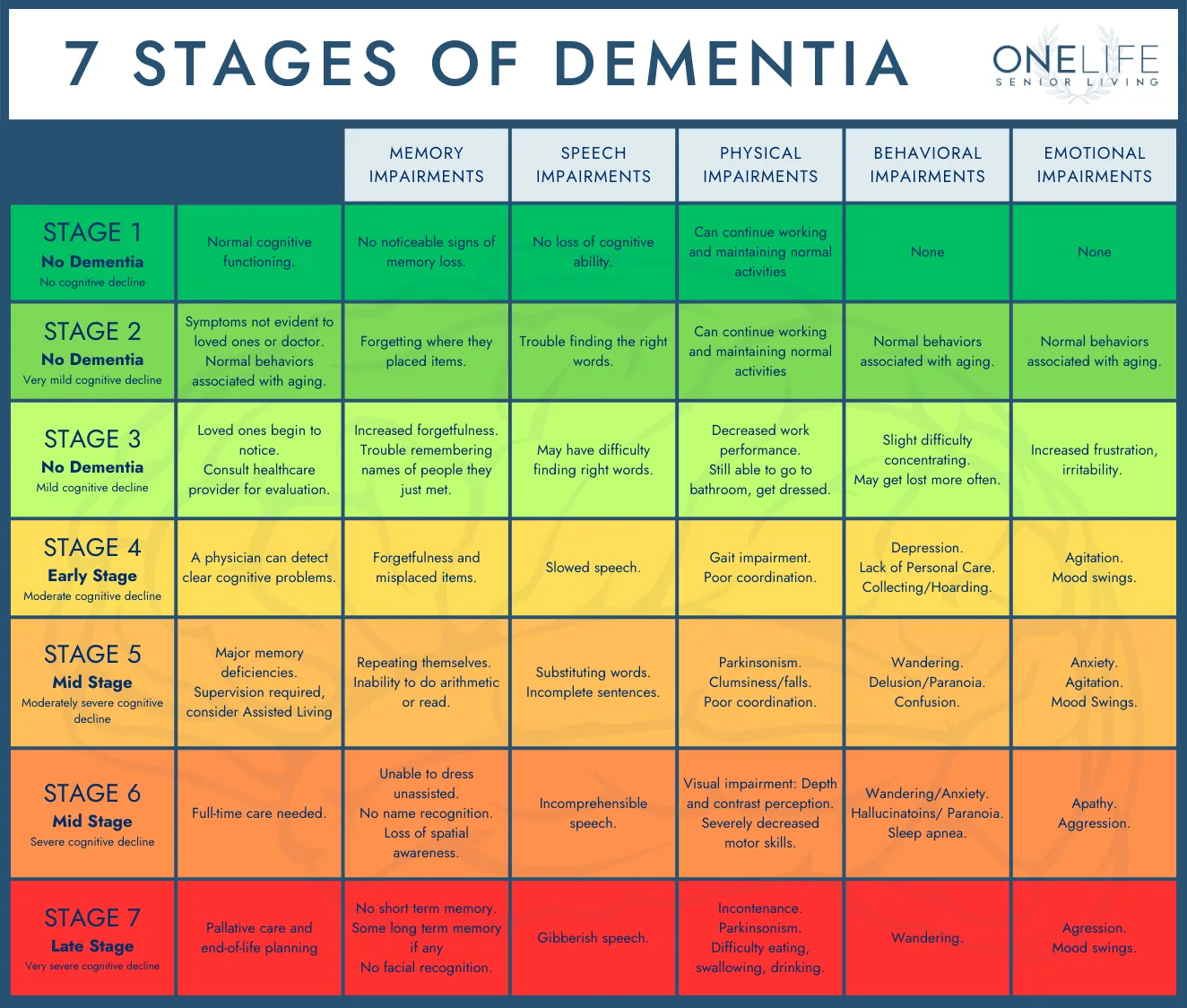
Learn more about the 7 Stages of Dementia
Explore ONELIFE Communities Near You
ONELIFE Senior Living is proud to serve families in multiple regions, offering exceptional care and support tailored to each resident’s needs. In Springfield, Oregon, The Esther at Riverbend Assisted Living provides personalized assisted living services, while The Rawlin at Riverbend Memory Care specializes in compassionate Alzheimer’s and dementia care. Families in Salem can find trusted support at Battle Creek Memory Care, and those in Beaverton benefit from the warm, secure environment at Waterhouse Ridge Memory Care.
For families in Nevada, Vineyard Henderson Memory Care offers expert dementia care in the heart of Henderson, while in California, The Reserve at Fountaingrove Memory Care provides high-quality memory support in Santa Rosa, and The Woodlake Senior Living serves Sacramento with a full spectrum of senior living options. In Cottage Grove, Oregon, Middlefield Oaks Senior Living combines independence and care, while in the Midwest, The Laurel at Vernon Hills Memory Care stands as a dedicated resource for families in Vernon Hills, Illinois. Finally, in Phoenix, Arizona, Shadow Mountain Memory Care delivers compassionate, all-inclusive memory care in a safe and engaging setting.
No matter which location you choose, every ONELIFE community is united by the same mission: providing exceptional care, meaningful activities, and a true sense of family for residents and loved ones.