Understanding dementia can feel overwhelming for families. One of the most common questions caregivers ask is: “How can you tell what stage of dementia a person is in?” Recognizing the stage helps families anticipate changes, make informed care decisions, and ensure their loved one receives the right level of support.
This guide explains how dementia is diagnosed, what the stages look like, and how professional care — including respite services — can help families along the journey.
How Is Dementia Diagnosed?
Dementia isn’t a single disease but a group of conditions affecting memory, reasoning, and daily functioning. According to the Alzheimer’s Association, diagnosis typically involves:
- Medical history & physical exam – Doctors review symptoms, medications, and overall health.
- Cognitive assessments – Tests measure memory, problem-solving, attention, and language skills.
- Lab tests & brain imaging – Blood tests and MRI or CT scans may help rule out other causes.
- Neurological evaluation – Specialists may assess reflexes, balance, and sensory response.
A dementia diagnosis is rarely based on one test alone — instead, it comes from a combination of medical, cognitive, and behavioral evaluations.
👉 Learn more about ONELIFE’s Memory Care services and how personalized support can ease the transition after diagnosis.
Understanding the Stages of Dementia
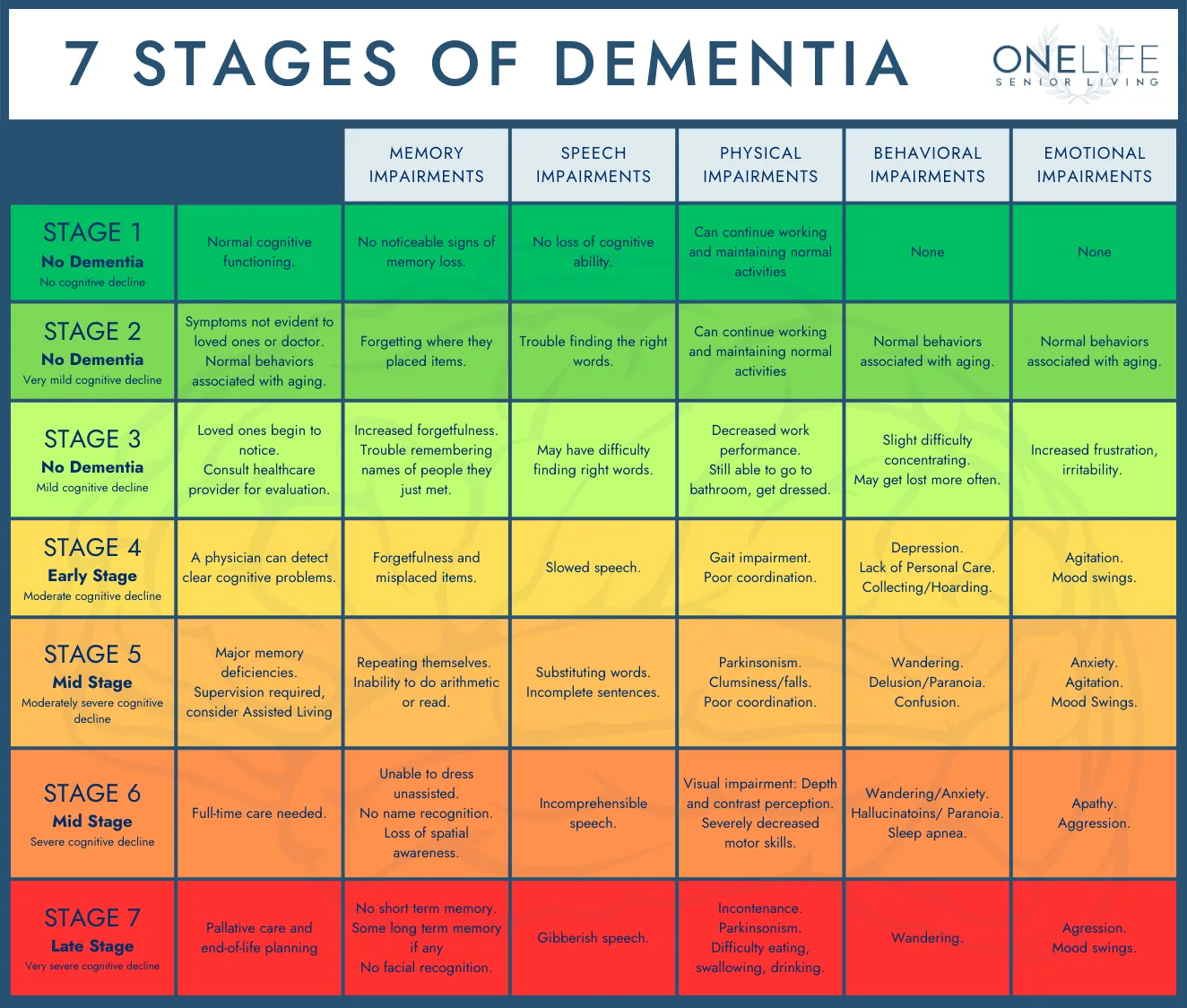
Dementia progresses gradually, and symptoms vary by person. However, healthcare professionals often use a 7-stage scale (known as the Global Deterioration Scale) to describe changes:
Early Stages (1–3): Subtle Changes
- Stage 1: No noticeable symptoms, but brain changes may begin.
- Stage 2: Very mild forgetfulness (often mistaken for normal aging).
- Stage 3: Increased difficulty finding words, losing things, or managing complex tasks.
Middle Stages (4–5): Noticeable Impact on Daily Life
- Stage 4: Forgetting recent events, trouble managing finances or cooking.
- Stage 5: Needing help with dressing, confusion about time or place.
Later Stages (6–7): Advanced Dementia
- Stage 6: Personality changes, incontinence, wandering, needing daily assistance.
- Stage 7: Loss of ability to speak, walk, and eat independently.
Families often notice that their loved one doesn’t fit neatly into one stage — overlapping symptoms are common. Still, staging provides a helpful framework for planning care.
How Fast Do the Stages of Dementia Progress?
One of the most difficult parts of dementia is its unpredictability. Progression looks different for every person, depending on age, type of dementia, and overall health.
According to the Alzheimer’s Society, the three broad stages of dementia typically last:
- Early stage: ~2 years
- Middle stage: 2–4 years
- Late stage: 1–2 years
It’s important to remember these are averages. Some people remain stable for many years, while others progress more quickly. Families should focus less on timelines and more on adapting care to their loved one’s current abilities and needs.
Signs That Help Identify the Stage of Dementia
While only a healthcare professional can confirm staging, families may notice signs such as:
- Memory loss severity – Occasional forgetfulness vs. forgetting names of close family.
- Communication changes – Trouble finding words vs. losing ability to speak.
- Independence level – Needing reminders vs. needing full daily care.
- Behavioral changes – Mild mood shifts vs. severe agitation or withdrawal.
If you’re unsure, consider keeping a journal of symptoms to share with your loved one’s doctor. This can provide clarity and help track progression.
The Role of Respite Care in Dementia Support
Caring for someone with dementia can be physically and emotionally draining. Even when families can manage at home, short breaks are essential.
Respite care provides temporary, professional support for individuals with dementia, giving caregivers time to rest, travel, or handle personal responsibilities while knowing their loved one is safe.
Benefits of respite care include:
- 24/7 professional supervision
- Medication management
- Engaging memory-support activities
- Nutritious meals and assistance with daily tasks
At ONELIFE communities, respite care also offers families a chance to “test the waters” of memory care before committing to a long-term decision.
👉 Learn more about Respite Care at ONELIFE.
Summary
Knowing what stage of dementia a person is in helps families prepare for the future, connect with resources, and provide the best care possible. While diagnosis should always be made by a healthcare professional, families can look for common signs to understand when it’s time to seek additional support.
ONELIFE Senior Living is here to walk with you through every step — from early diagnosis to compassionate memory care services and caregiver relief through respite stays. Find a community near you!
Related Resources
- How long each stage of dementia lasts
- Signs dementia is getting worse
- Late-stage dementia: what to expect
- How to care for someone at each stage
Frequently Asked Questions
1. What is the first noticeable sign of dementia?
Often, difficulty remembering recent events or conversations is the earliest sign.
2. Can dementia be diagnosed with a brain scan?
Brain scans can help rule out other causes and show patterns of brain changes, but diagnosis relies on multiple assessments.
3. How many stages of dementia are there?
Most experts use a 7-stage model, though some healthcare providers simplify it into 3 broad phases (early, middle, late).
4. How do doctors test for dementia?
Through cognitive testing, medical history, lab work, imaging, and sometimes neurological exams.
5. Can someone move quickly from one stage of dementia to another?
Yes — progression varies by individual and can be influenced by overall health and type of dementia.
6. How does respite care help families?
It allows caregivers to rest while their loved one receives professional, round-the-clock support in a safe community setting.
7. When should families consider memory care?
When safety, health, or daily independence becomes difficult to manage at home, a specialized memory care community can provide the right environment.
Explore ONELIFE Communities Near You
ONELIFE Senior Living is proud to serve families in multiple regions, offering exceptional care and support tailored to each resident’s needs. In Springfield, Oregon, The Esther at Riverbend Assisted Living provides personalized assisted living services, while The Rawlin at Riverbend Memory Care specializes in compassionate Alzheimer’s and dementia care. Families in Salem can find trusted support at Battle Creek Memory Care, and those in Beaverton benefit from the warm, secure environment at Waterhouse Ridge Memory Care.
For families in Nevada, Vineyard Henderson Memory Care offers expert dementia care in the heart of Henderson, while in California, The Reserve at Fountaingrove Memory Care provides high-quality memory support in Santa Rosa, and The Woodlake Senior Living serves Sacramento with a full spectrum of senior living options. In Cottage Grove, Oregon, Middlefield Oaks Senior Living combines independence and care, while in the Midwest, The Laurel at Vernon Hills Memory Care stands as a dedicated resource for families in Vernon Hills, Illinois. Finally, in Phoenix, Arizona, Shadow Mountain Memory Care delivers compassionate, all-inclusive memory care in a safe and engaging setting.
No matter which location you choose, every ONELIFE community is united by the same mission: providing exceptional care, meaningful activities, and a true sense of family for residents and loved ones.